We may earn money or products from the companies mentioned in this post.
Peripheral neuropathy exercises need precise individualization, and generic advice consistently misses this reality. When your feet cannot fully register the ground beneath them or your ankles refuse to respond as they once did, you need something far more specific than a photocopied handout with ten exercises and vague encouragement.
You need a plan that matches what your body can safely accomplish right now, today, considering your specific pattern of numbness, weakness, balance difficulties, and the actual condition of your feet.
Quick answer: Peripheral neuropathy exercises should fit your sensation, strength, balance, foot condition, and underlying cause. Supported strength work, mobility, suitable aerobic activity, and supervised balance practice are categories to discuss—not a universal routine. New weakness, falls, or a foot wound need assessment before you push ahead.
I start by asking what needs a professional assessment: sensation, strength, balance, and the physical condition of the feet. Those are questions to work through with a qualified clinician or physical therapist, not tests I can perform for you through an article.
Only after those questions are addressed does choosing suitable movements make sense to me.
This approach involves building sustainable activity that your nervous system and your feet can realistically handle without creating extra problems. Two people carrying the same peripheral neuropathy diagnosis can have completely different needs. One person might experience mild tingling with preserved strength and balance, while another might face severe numbness, foot drop, and a history of falls.
The second person attempting the first person’s routine could end up seriously injured, and that represents a planning failure rather than a personal shortcoming.
Understanding What Exercise Can and Cannot Do
I want to be clear about expectations: exercise is not a guaranteed cure for peripheral neuropathy or a reliable way to restore normal sensation. Whether nerves recover depends on the cause, severity, and treatment. Promises that one routine reverses everyone’s neuropathy go beyond the evidence.
Appropriately selected activity can support strength, mobility, fitness, and everyday function. A randomized trial of hand and foot exercises in diabetic peripheral neuropathy reported improvements in motor scores and some daily activities. That does not establish that every routine suits every cause of neuropathy or that it repairs nerve damage.
The NHS treatment overview also describes physiotherapy for weakness and emphasizes addressing the underlying cause when possible. Exercise belongs within that broader plan.
For people with diabetes, activity may also help glucose management and general health. I value those gains without treating improved walking confidence as proof of nerve regeneration.
Assessing Your Starting Point
Before changing anything about your activity level, you need an honest inventory of four critical areas. I walk through each one because skipping this step causes the most common problems.
Foot Condition Comes First
When sensation decreases, your feet can sustain injury without your awareness. A pressure point that would normally feel uncomfortable and prompt you to adjust your shoe might progress to a blister, then an open sore, without ever registering as pain. This concern intensifies for people with diabetes, where impaired circulation compounds the problem and changes a small wound into a serious medical issue.
You need to physically examine your feet every single day. Check the soles, between the toes, around the heels, and anywhere your shoes contact skin. Look for any broken skin, redness, swelling, warmth, bruising, drainage, or changes in skin color.
If you cannot easily see the bottoms of your feet, use a handheld mirror or ask someone to help you.
A developing problem caught early becomes vastly easier to manage than one ignored for days.
If you find an open wound, significant redness, increasing swelling, or signs of infection, pause activity that loads or rubs the affected foot and contact your healthcare team promptly. Ask which activities, if any, can continue while the problem is assessed.
Balance and Fall History Matter Enormously
If you have fallen, nearly fallen, started grabbing onto walls or furniture for stability, or noticed that dim lighting makes you feel particularly unsteady, these signs show your balance system has become compromised and unsupported balance training could prove dangerous.
Reduced sensation in your feet means you receive less proprioceptive feedback about where your feet exist in space and how weight distributes. Many people compensate by relying more heavily on vision, which explains why poor lighting or uneven ground becomes so challenging.
Vision alone cannot prevent all falls quickly enough, especially if your ankle or leg muscles respond weakly or slowly.
This situation does not eliminate balance work. It means balance work needs assessment and progression with suitable support rather than tries from a YouTube video while standing on one leg with your eyes closed. That type of challenge drill assumes you possess reliable sensory feedback and quick muscular responses, which peripheral neuropathy directly compromises.
Weakness Changes Everything
Dragging your toes when you walk, catching your foot on small obstacles, rolling an ankle, having trouble lifting the front of your foot, or needing to push off furniture to stand up all signal weakness deserving proper assessment. Weakness represents a real functional limitation affecting safety that needs strategic addressing.
A physical therapist can assess which specific muscles are weak, how that weakness affects your movement patterns, and whether you need an ankle-foot orthosis, a walking aid, different footwear, or a targeted strengthening program. Sometimes the weakness localizes, like foot drop from peroneal nerve involvement.
Other times weakness becomes more generalized from inactivity, deconditioning, or the systemic effects of the underlying condition causing the neuropathy.
The exercise plan for someone with isolated foot drop will look dramatically different from the plan for someone with generalized leg weakness or someone whose main limitation involves hip weakness affecting stair climbing. Generic strengthening routines fail to account for these differences.
Symptom Progression Functions as a Warning
If your numbness, pain, weakness, or balance rapidly worsens, if symptoms newly affect your hands or arms, or if you have unexplained weight loss, severe night pain, or fever, you need medical evaluation before starting an exercise program. Peripheral neuropathy has many possible causes, and some progress rapidly, respond to treatment, or associate with other serious conditions requiring attention.
Exercise cannot substitute for diagnosis and treatment of the underlying cause. In some situations, jumping into an exercise program while the cause stays uncontrolled or undiagnosed can prove counterproductive or even harmful.
Four Activity Categories to Consider
I organize activity planning into four broad categories, and the right approach for you might involve one of them, a combination, or a temporary choice while another issue receives attention. None of these automatically proves superior to the others.
Supported Strength Work
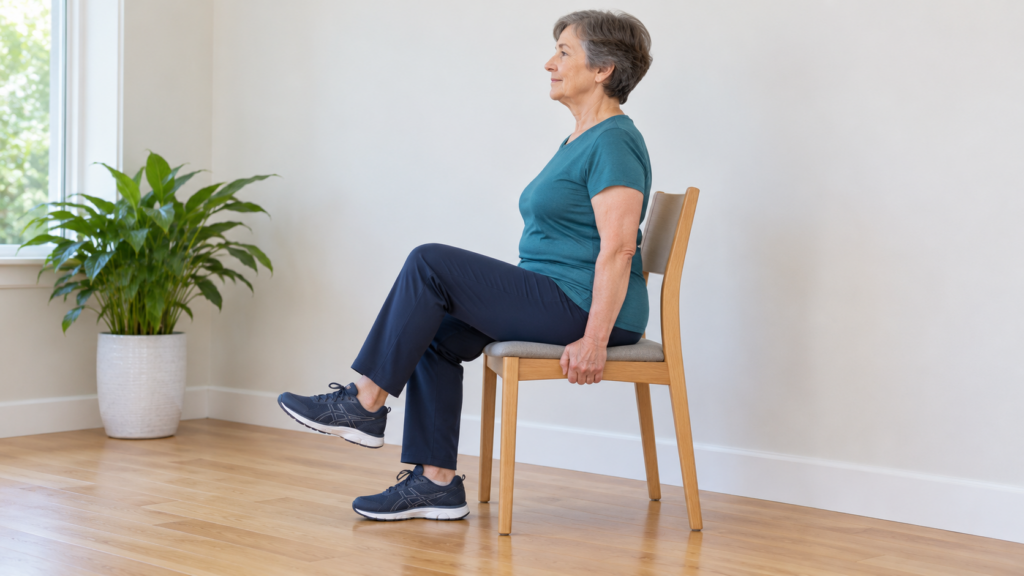
The lead illustration shows a seated march, one of the movements demonstrated in the NHS sitting-exercise guide. The image is an example to discuss with a therapist, not a recommendation that everyone should copy it or use the same range.
Strengthening exercises make sense when weakness, inactivity, or fear of movement has reduced your function. The key word here stays “supported.” I mean exercises performed while seated, lying down, or with a stable surface like a countertop or parallel bars to hold onto.
This might include bodyweight movements, resistance bands, ankle weights, or gym equipment, depending on what becomes available and suitable for your situation.
The specific exercises should target the actual weakness. If you have foot drop, assessment may lead to supported ankle work, a brace, or another treatment depending on its cause. The NHS foot-drop guidance describes several options; strengthening alone is not the answer in every case.
If your main issue involves difficulty rising from a chair, you might need hip and quadriceps work.
If you have become generally deconditioned from avoiding activity, you might need a broader program.
A therapist can determine the suitable resistance, range of motion, level of support, and progression strategy. They can also replace risky movements with safer choices that work the same muscle groups.
For example, a standing heel raise that feels unstable might be practiced seated first, or a balance-dependent movement might be broken down into a strength component practiced with support and a separate balance component practiced with different precautions.

The supported calf-raise illustration shows a strength movement with a fixed surface for support. It is based on the NHS strength-exercise demonstration, with a counter replacing the chair back. It does not show a progression to unsupported balancing. A therapist can decide whether this, a seated alternative, or another movement is appropriate.
Mobility and Flexibility
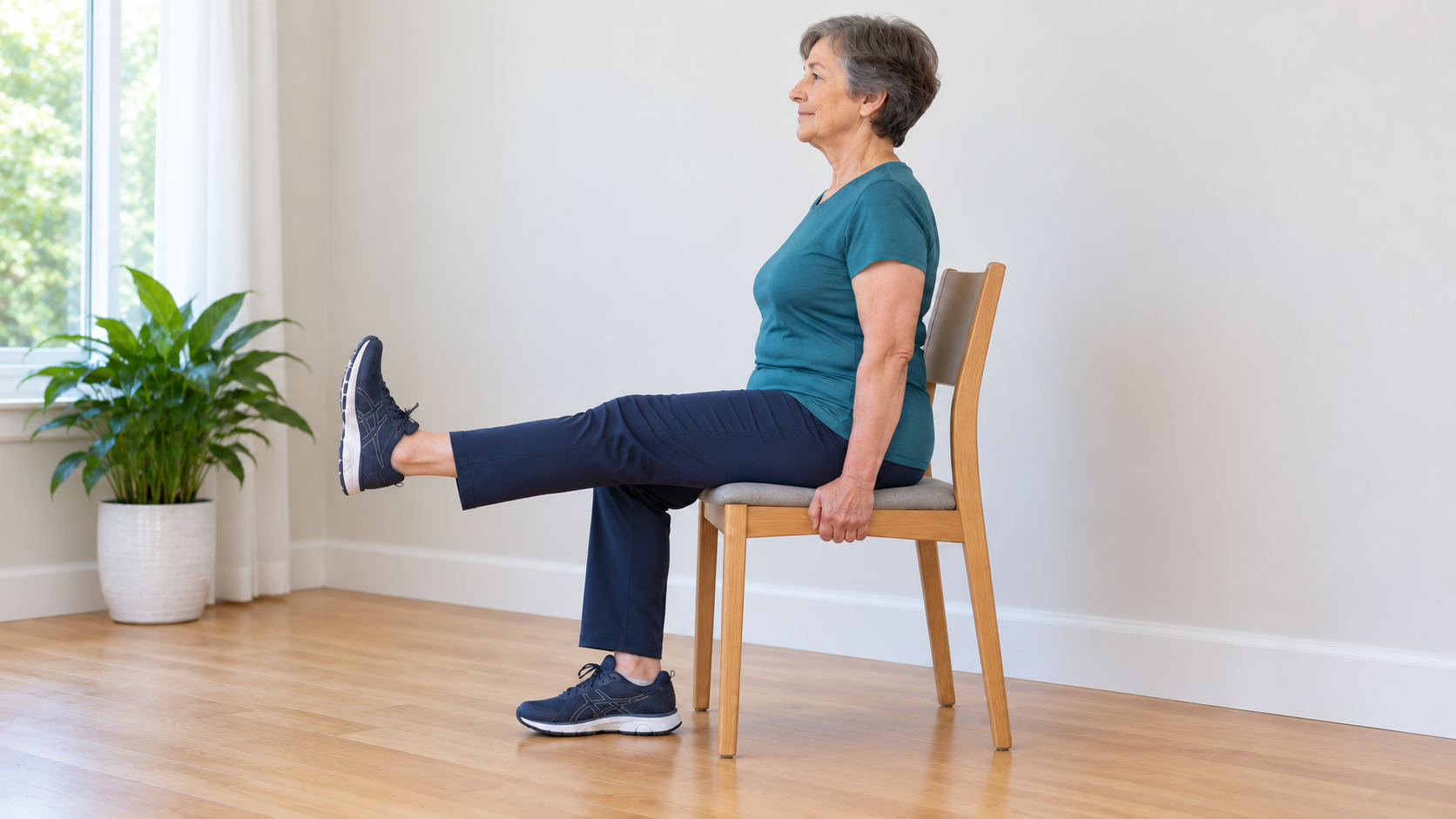
The ankle-mobility illustration shows one position in a seated ankle movement. The intended motion is at the ankle while the leg is supported by the seated position; the range and whether the knee should be extended need to suit your assessment.
Gentle mobility work helps preserve range of motion at the ankles, knees, hips, and other joints. This becomes particularly important after prolonged sitting or when pain and reduced activity have made movement feel stiff or restricted.
The challenge with stretching and mobility work when you have peripheral neuropathy centers on your inability to rely on pain as your guide for “too much.” Normal pain and discomfort function as warning signals that tell you when you approach tissue limits or create excessive stress. When those signals become dulled or absent, you can overstretch, create pressure in a bad position, or aggravate a nerve without realizing it until much later.
A therapist can teach you how to gauge suitable stretch and movement without relying exclusively on pain. This might involve using visual cues, paying attention to muscle tension rather than discomfort, staying within predetermined ranges, and avoiding extreme positions with numb areas.
Aerobic Activity
Aerobic exercise raises your heart rate and breathing rate and provides cardiovascular conditioning. For people with peripheral neuropathy, the challenge involves finding an option that does not create unacceptable foot loading, balance risk, or injury potential.
Walking seems the obvious choice, and for many people with mild symptoms and good balance, it works well. Walking on uneven outdoor terrain with reduced sensation and poor balance becomes a completely different proposition from walking on a smooth indoor track.
Context matters enormously.
A suitably fitted stationary or recumbent cycle may reduce some walking demands, if transfers and pedal contact are manageable. Outdoor cycling still requires balance, coordination, and safe stopping; it is not equivalent to a supported stationary bike. Foot positioning and pedal pressure need attention either way.
Swimming reduces impact and weight-bearing stress, but it introduces other considerations. Pool decks often become wet and slippery.
Getting in and out of the pool requires balance and strength.
If you have an open wound on a foot, ask your healthcare team before using a pool; swimming is not an automatic substitute for walking while a wound heals. Swimming does not automatically become safe simply because it qualifies as low-impact.
Seated exercise options, whether using upper body movements, seated pedal devices, or chair-based routines, can provide value for people who need to maintain cardiovascular fitness while foot-loading stays temporarily unsuitable or balance stays too compromised for standing work.
The often-cited guideline of 150 minutes of moderate activity per week represents a general adult health recommendation rather than a starting prescription for someone with neuropathy, balance problems, or active foot issues. Your starting duration and progression may need to be much smaller and should fit your individual care plan.
Individually Supervised Balance Work
Balance training can include supported weight shifting, stepping patterns, directional changes, gait practice on predictable surfaces, or carefully progressed sensorimotor activities. The suitable level depends entirely on how much sensory information you receive from your feet and joints, how well your vision compensates, and whether your leg muscles can react quickly enough to prevent a fall.
This category produces the most misguided advice I see. People receive instructions to practice standing on one leg, stepping onto unstable surfaces, or closing their eyes during balance exercises without any assessment of whether their sensory and motor systems can actually manage those challenges safely.
The result becomes falls, injuries, and understandable loss of confidence.
Balance work should start with the level of support a professional has determined suitable for you. That might mean standing with both hands on a counter initially, then one hand, then fingertip contact, then nearby support you do not touch, then no support.
Or it might mean seated weight-shifting first, then supported standing, with unsupported standing becoming a much later goal.
Do not practice difficult balance drills alone, on slippery floors, on wobble boards, on uneven outdoor surfaces, or with your eyes closed unless a qualified professional has specifically assessed your abilities and instructed you to do so. The risk does not justify it.
Tailoring the Plan to Your Specific Situation
A useful assessment involves more than being told to “move more” or being handed a generic exercise sheet. A physical therapist experienced with neurological conditions can examine your walking pattern, looking at speed, step length, toe clearance, and turning strategy.
They can test leg, ankle, and foot strength in specific muscle groups. They can measure joint range of motion and assess balance in sitting, standing, and walking.
They will also look at how you compensate. Are you using vision heavily because proprioception has reduced?
Are you taking smaller steps to feel more stable?
Are you avoiding weight shift onto one leg? Are you hiking your hip to clear your foot instead of lifting your ankle?
These compensations tell an experienced therapist considerable information about where the problems exist and what interventions might help.
The therapist can then adjust position, surface, support, pace, resistance, and complexity to match your abilities and safety needs. They can replace risky exercises with similar movements in safer positions. They can show you how to practice a functional task like turning or stepping over an obstacle with the right amount of support and the right environmental setup.
The cause also matters. Chemotherapy-induced, hereditary, alcohol-related, nutritional, and diabetes-related neuropathies are not interchangeable. Evidence and treatment needs differ between conditions, so I would not assume that one population’s exercise program transfers directly to another.
You cannot simply copy a routine designed for diabetic neuropathy and assume it applies to your situation.
Practical Safety Measures
Footwear Considerations
Your exercise shoes need to fit comfortably, stay secure during movement, and avoid creating pressure or friction. Pay attention to the toe box width and height, heel counter stability, cushioning, how the shoe fastens, internal seams, and whether the shoe stays on your foot without you having to grip it with your toes.
Shoes do not treat neuropathy, but suitable fit can reduce avoidable injury. If you compare options, focus on fit-related factors rather than marketing claims.
My shoe comparison can help narrow choices, but it cannot replace a professional foot assessment, especially when deformity exists, a history of ulcers has occurred, significant swelling appears, or a need for therapeutic footwear or custom orthotics develops.
Environmental Setup
Your surroundings matter as much as the exercise itself. Remove loose rugs, clutter, and trailing cables from exercise areas.
Use good lighting, especially for any movement requiring precision or balance.
Keep stable support nearby for any standing activities. Avoid exercising on wet, icy, very hot, or uneven surfaces when sensation has reduced.
Do not exercise barefoot on surfaces where you could step on something sharp, hot, or rough without noticing immediately. If falls represent a real concern, use a companion or practice only in supervised settings until you have built more stability.
Before and After Inspection
For people with reduced sensation, a quick inspection routine before and after activity can catch problems that symptoms will not reveal. Before putting on your shoes, check inside them for grit, folded material, rough seams, or objects that should not be there.
After activity, check your feet for any redness, warmth, swelling, blisters, pressure marks, or skin changes.
This becomes particularly important for people with diabetes because diabetes can damage both nerves and blood vessels, creating conditions for foot complications. The combination of reduced sensation, impaired healing, and potential circulation problems means that small injuries can become serious quickly.
Special Considerations for Diabetic Neuropathy
As NIDDK explains, physical activity can affect blood glucose during exercise and for hours afterward. This becomes particularly relevant for people using insulin or medications like sulfonylureas that can cause hypoglycemia.
You need an individualized plan from your diabetes care team that covers glucose monitoring before, during, and after activity, carbohydrate intake, hydration, and medication timing. Do not independently change insulin doses or other medications because you have started exercising.
Low blood glucose can occur hours or even a day after activity in some circumstances, and you need to know how to recognize and treat it.
Diabetes also adds specific considerations around balance activities and exercise safety. The combination of peripheral neuropathy affecting sensation in the feet and potential vision changes from diabetic retinopathy can make certain balance exercises particularly risky.
Your diabetes care team can help you identify which activities prove suitable rather than assuming a standard balance routine works fine.
Tracking and Adjusting Your Activity
I strongly recommend keeping a symptom and activity record, especially in the first several weeks of a new program. This proves more useful than trying to match someone else’s routine or hit arbitrary targets.
Record what activity you did and how it was modified, how long you remained active, what footwear you wore and what surface you used, and any changes in pain, tingling, numbness, fatigue, or weakness before and after the activity. Note any changes in walking confidence or balance, any foot redness or skin changes, how long it took you to feel back to your usual baseline, and if you have diabetes, whatever glucose information your care team has requested.
Try to change one variable at a time when possible. If you increase duration, do not also change the exercise type and footwear in the same session.
That way, if something causes a problem, you have a better chance of identifying what it was.
If a new activity produces a persistent increase in symptoms, new weakness, a change in your walking pattern, or a foot problem, stop that activity and get advice rather than pushing through. Do not assume that discomfort is harmless when sensation is reduced.
New nerve symptoms, balance changes, or injuries you might not fully feel deserve attention rather than an assumption that you should push through.
When to Stop and Get Help
Stop the activity and get clinical advice about new or worsening weakness, repeated near-falls, a new fall, difficulty lifting a foot, a change in walking, or symptoms that remain substantially worse afterward.
A blister, cut, ulcer, bleeding, increasing foot redness, heat, swelling, or drainage needs prompt assessment, particularly with diabetes. Fever with a worsening foot problem also warrants urgent medical attention.
Seek emergency help for chest pain suggestive of a heart attack, severe breathing difficulty, collapse, or loss of consciousness. In the US, call 911. Do not treat these as ordinary exercise fatigue. The NHS heart-attack guidance explains why these symptoms can require emergency care.
If you suspect low blood glucose, stop and follow the treatment plan your diabetes team has given you. Severe symptoms, inability to treat it safely, or loss of consciousness require emergency help. See NIDDK’s hypoglycemia guidance; do not simply wait for exercise symptoms to pass.
Frequently Asked Questions
Can I walk with peripheral neuropathy in my feet?
Walking with peripheral neuropathy stays possible for many people, but it depends on your specific symptoms and balance. If you have mild numbness with good balance and no foot wounds, walking on smooth, well-lit surfaces may work well.
If you have severe numbness, balance problems, or a history of falls, you need a professional assessment first.
Walking on uneven outdoor terrain with reduced foot sensation creates significant fall risk.
What exercises help with foot drop from neuropathy?
Foot drop needs assessment of its cause and how much movement remains. A physical therapist may teach supported ankle movements or strengthening when appropriate, but a band exercise is not automatically suitable for every weak or numb foot.
Some people also benefit from a fitted brace or ankle-foot orthosis to improve foot position while walking.
The exercises alone usually cannot fully compensate for severe weakness.
Is cycling safe for diabetic neuropathy?
A stationary or recumbent bike may be an option after checking transfers, fit, pedal pressure, and symptoms. Outdoor cycling has its own balance and stopping demands, so it should not be treated as automatically safer than walking.
You need to check your feet before and after cycling for any pressure areas or skin changes, ensure proper foot positioning on the pedals, and watch blood glucose according to your diabetes care team’s guidance.
Can balance exercises make neuropathy worse?
Balance exercises performed incorrectly can lead to falls and injuries that worsen your overall situation. Balance training needs to match your current sensory and motor abilities.
Attempting difficult balance drills like standing on one leg or using unstable surfaces without professional assessment creates unnecessary risk.
Appropriately supervised balance work may improve function, but the level of support and progression still need to suit the person.
What are the best shoes for exercising with neuropathy?
The best shoes for exercising with neuropathy fit your feet comfortably without creating pressure points or friction. Look for shoes with adequate toe box width and height, secure heel counters, good cushioning, reliable fastening that keeps the shoe on without toe gripping, and smooth interior seams.
Avoid shoes that are too tight, too loose, or have rough internal areas. Some people need therapeutic footwear or custom orthotics prescribed by a podiatrist.
How often should I check my feet when exercising with neuropathy?
Check your feet every single day regardless of exercise, and inspect them both before and after each exercise session. Look at the soles, between toes, around heels, and anywhere shoes contact skin. Check for redness, warmth, swelling, blisters, cuts, bruises, or skin changes.
If you find any open wounds or concerning changes, stop exercising and contact your healthcare provider.
Can strength training help peripheral neuropathy symptoms?
Strength training is not a guaranteed way to repair nerve damage or restore sensation, but it may improve strength and everyday function. Strengthening exercises help you use available muscle strength more effectively, maintain independence with daily activities, and potentially reduce fall risk.
The exercises need to be performed in supported positions appropriate for your balance and weakness pattern.
Is swimming good exercise for neuropathy?
Swimming reduces impact and weight-bearing stress, making it appealing for neuropathy exercise. However, pool decks can be wet and slippery, getting in and out requires balance and strength, and an open foot wound needs advice from your healthcare team before pool use.
If these factors can be safely managed, swimming provides excellent cardiovascular conditioning.
Key Takeaways
Peripheral neuropathy exercise planning must match your specific pattern of sensation loss, weakness, balance impairment, foot condition, and underlying cause. Generic routines ignore these critical differences and create unnecessary risk.
Exercise is not a guaranteed cure or nerve-repair treatment. When selected and progressed appropriately, it may support strength, fitness, function, and quality of life.
Foot inspection before and after activity stays essential when sensation has reduced, particularly for people with diabetes.
Balance exercises need professional guidance and appropriate support when sensation, vision, or muscle response has become impaired.
Walking represents one option among many and may not be the safest option depending on your balance, foot condition, and symptom severity.
Diabetes adds specific exercise considerations around blood glucose monitoring, hypoglycemia risk, foot care, medication timing, and activity selection that need guidance from your diabetes care team.
A symptom and activity diary helps you identify what works, what needs adjustment, and when something has gone wrong before it becomes a bigger problem.
Stop activity and seek medical advice for new weakness, falls, foot wounds, increasing swelling or redness, unusual symptoms, or anything that stays significantly worse after normal recovery time.
If symptoms also disturb your sleep, see my guide to peripheral neuropathy at night for comfort measures and questions to discuss with your clinician.
This article is educational and does not replace individual medical advice. The images are AI-generated editorial illustrations using real NHS exercise demonstrations as posture references. They are not patient photographs or a personalized exercise prescription.